
Sustainable Shoe Design

By Nadia Brooks
Sustainable shoe design begins before a material is chosen. It considers how the shoe will be made, worn, maintained, repaired and handled at the end of its useful life. The aim is not to attach a broad environmental…
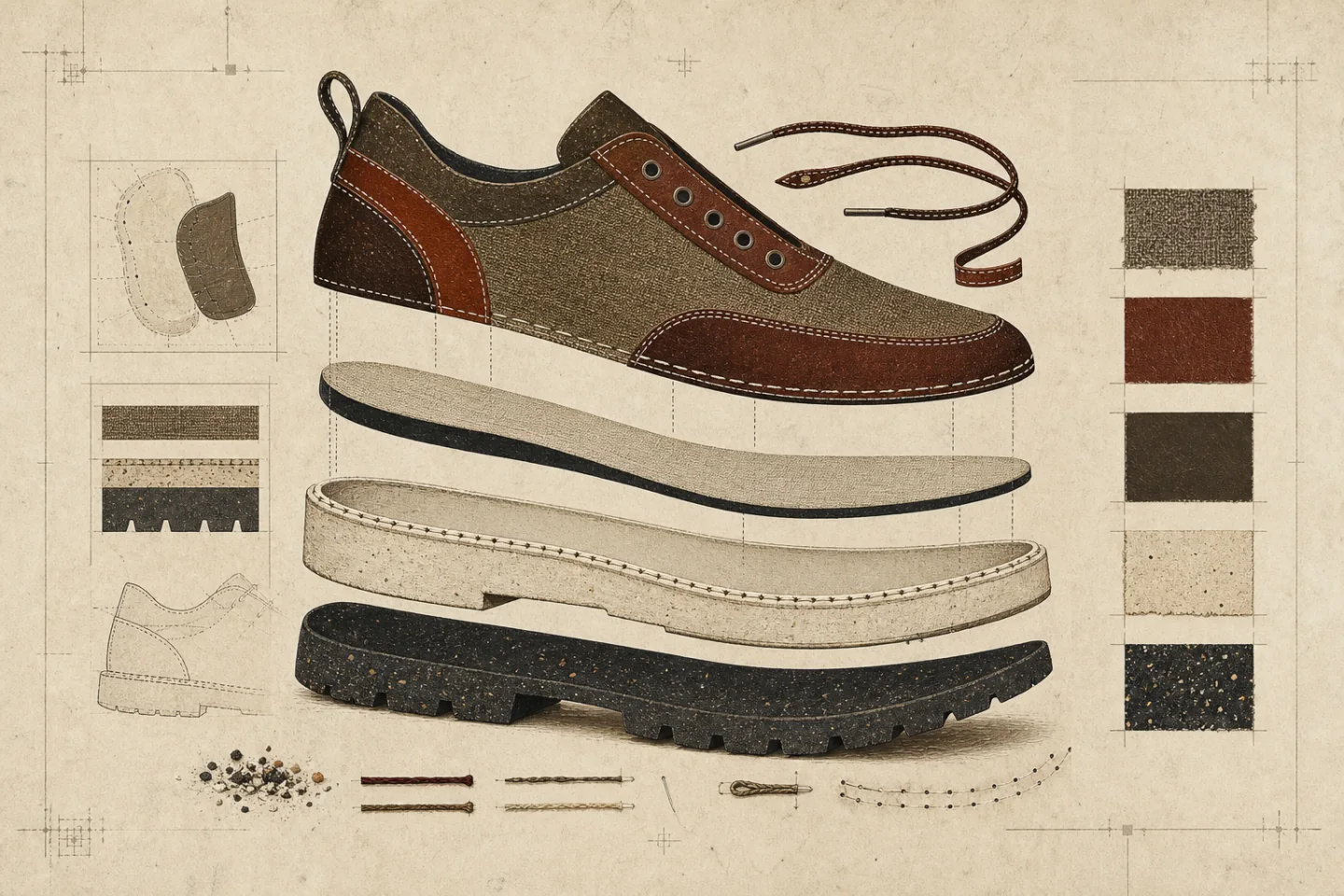
Sustainable shoe design begins before a material is chosen. It considers how the shoe will be made, worn, maintained, repaired and handled at the end of its useful life. The aim is not to attach a broad environmental label to one component, but to reduce avoidable impacts across the whole product.
Every decision involves trade-offs. A light material may use less raw material but wear out quickly. A durable bond may extend service life but prevent disassembly. A recycled component may still depend on hazardous finishes or an opaque supply chain. Good design makes these tensions visible, tests them against the shoe’s intended use and records why each choice was made.
Start with a clear design brief
Define the shoe’s purpose, expected conditions and likely wear points before drawing the final construction. A walking shoe, protective boot and occasional dress shoe require different levels of grip, flex, water resistance and repair access. Environmental choices must not undermine safety, fit or useful life.
An ecodesign approach for footwear helps a team examine impacts while changes are still practical. A useful brief should state:
- the intended activity, climate and expected frequency of use;
- the service-life target and the tests used to assess it;
- which parts are expected to wear first and whether they can be replaced;
- material, chemical and labour requirements for suppliers;
- the realistic route for repair, reuse or material recovery.
Choose materials as a system
Assess the upper, lining, reinforcement, midsole, outsole, adhesive, finish, hardware and packaging together. A small recycled trim does not determine the impact of the finished shoe. Ask suppliers for the full composition, recycled or bio-based content, origin, coatings, process chemicals and evidence behind each claim.
Recycled polymers can reduce demand for virgin feedstock, while fibres such as hemp, linen, wool or responsibly sourced natural rubber may suit some applications. Neither category is automatically preferable. Compare abrasion resistance, flex life, moisture behaviour, colourfastness and cleaning needs. A material that fails early or requires a protective plastic coating may weaken the original case for using it.
Terms such as natural, bio-based and biodegradable are not interchangeable. A plant-derived polymer may persist like a conventional plastic, and a compostable material may break down only in controlled industrial conditions. Specifications should describe what a material contains and the conditions under which any end-of-life claim applies.
Reduce waste in pattern and production
Waste prevention starts with the pattern. Nest pieces within the usable width and shape of a material, reduce decorative overlays, and adjust seams where this improves cutting yield without weakening support. Digital layouts can compare alternatives before physical material is cut.
Factories should record waste and defects at each stage: cutting, stitching, lasting, bonding and finishing. Clean offcuts kept separate by material have more reuse options than scraps contaminated with mixed fibres, coatings and adhesive. Tracking the reason for rejected parts also allows a recurring alignment, fit or bonding problem to be corrected before it produces finished waste.
Changing an adhesive or curing process requires performance testing. Lower-solvent or lower-temperature options may reduce some impacts, but only if the bond remains safe and durable under flex, moisture and heat. Production efficiency is useful when it supports a sound product, not when it shifts failures into the use phase.
Design for durability and repair
Identify high-wear zones and reinforce them without adding unnecessary layers elsewhere. Toe areas, heel counters, lace points and outsole edges often need particular attention. Test seam strength, sole adhesion, repeated flex, wet traction and compression according to the intended use rather than relying on a general claim of quality.
Make common failures repairable where the construction permits. Standard laces, removable insoles, replaceable heel pieces and accessible outsoles can keep an otherwise sound upper in use. Stitched or mechanical connections may offer better access than permanent bonding, although each method must still meet comfort, safety and weather requirements. Research into glueless mechanically assembled footwear illustrates how assembly choices can support later separation.
Repairability also depends on information and parts. Record the construction, identify compatible replacements and avoid placing seams or finishes where a routine repair would damage adjacent material. A theoretical repair route has little value if no repairer can reach the failed component.
Treat fit and care as environmental decisions
A durable shoe that fits poorly is unlikely to stay in use. Develop the last from measurements that represent the intended wearer, then test toe room, heel hold, width, instep volume and flex position. Where relevant, provide actual internal measurements and width information instead of vague statements about standard sizing.
Care guidance should match the specific materials. Explain how to clean and dry the shoe, whether conditioning is needed, which treatments may damage a finish and when a worn part should be repaired. Do not imply that painful footwear merely needs to be broken in. Clear guidance helps an owner respond to loose stitching, worn heels or lifting soles before the damage spreads.
Require traceable and responsible supply
Traceability should follow each important material from its origin through processing and assembly. At a minimum, identify the final factory and the suppliers responsible for major textiles, leather, rubber, foam and chemical treatments. For recycled content, record the feedstock, recycling process and verification method.
Labour requirements belong in the design and purchasing process, not in a separate statement. Supplier expectations should cover lawful pay, working hours, health and safety, freedom of association, grievance routes and control of subcontracting. Audits can identify problems, but they do not replace purchasing practices that allow realistic prices and production times.
Public claims should distinguish known facts from incomplete coverage. If traceability reaches only some components or supplier tiers, state that limit. Specific disclosure is more useful than a broad promise of an ethical or transparent supply chain.
Plan for circular use and end of life
First extend use through maintenance, repair and resale. Recycling is a later option, not a substitute for durability. When recovery is part of the brief, reduce incompatible material combinations, mark major components and make joins accessible. Removable hardware and separable soles can help, provided they do not shorten service life.
A collection programme needs a defined downstream route. State what it accepts, who sorts returned shoes and how each condition is handled. Wearable pairs may be cleaned or repaired; damaged pairs require a recycler able to process their actual combination of rubber, foam, textile, leather, metal and adhesive. Collection without evidence of the destination does not demonstrate circularity.
The collection and processing barriers are examined by Closing the Footwear Loop. Designers should still work from available local repair and recovery systems. A construction designed for a facility that cannot receive it has no practical end-of-life advantage.
Measure claims against the whole life cycle
A life cycle assessment can compare impacts across raw-material extraction, processing, manufacture, transport, use and end of life. Define the functional unit, system boundary, geography, data period and assumptions. For footwear, a comparison based only on one pair can mislead if the alternatives deliver different amounts of wear.
The inventory should include all major components, factory energy, production waste, packaging and freight. Results should be read alongside durability and repair evidence. footwear life cycle assessment research provides a more useful basis for improvement than unsupported labels such as “green” or “eco-friendly”.
Certifications can support narrow claims, such as the content of a textile or the chemical management of a process. They should not be presented as proof that every component or the whole shoe meets the same standard. State exactly what is certified, the percentage or component covered, and any exclusions.
A practical review before production
Before approving a design, review the evidence rather than the ambition. The team should be able to answer these questions:
- Does every material meet the performance need, and is its composition documented?
- Have fit, flex, traction, seam and bond risks been tested for the intended use?
- Can likely wear parts be maintained, repaired or replaced without destroying sound components?
- Are material origins, processing sites, labour requirements and subcontractors sufficiently visible?
- Are environmental claims specific, bounded and supported by suitable evidence?
- Is the proposed reuse or recovery route available in practice, with a known operator and destination?
A design that answers these questions clearly is easier to improve in later versions. It gives manufacturers practical specifications, gives wearers useful care information and replaces vague sustainability language with decisions that can be checked.