
Repairable Shoes: Ask These Construction and Service Questions
A worn sole does not have to end a shoe’s useful life. But “repairable” is a claim worth examining before you buy, and “recraftable” is not a promise that every worn pair can be saved. The useful question is specific:…
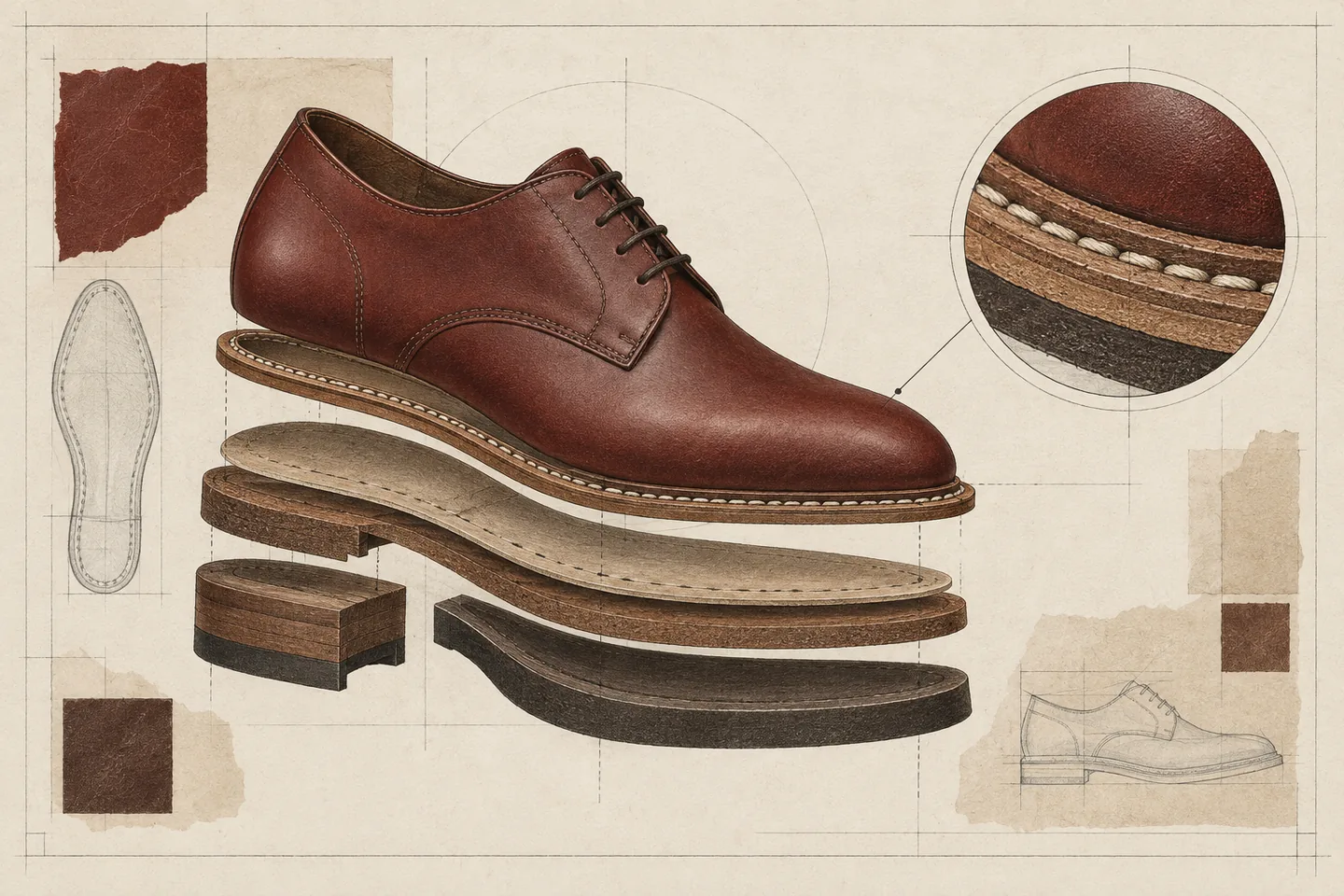
A worn sole does not have to end a shoe’s useful life. But “repairable” is a claim worth examining before you buy, and “recraftable” is not a promise that every worn pair can be saved. The useful question is specific: Can this model receive the repair I am likely to need, from a repairer I can actually use, while the rest of the shoe remains sound?
Check how the upper meets the sole, what service is available for the exact model, and whether an existing pair is sound enough to repair.
Read the construction claim carefully
“Welted,” “stitchdown” and “cemented” describe ways of joining a shoe’s parts, but none guarantees a repair service. A visible stitch does not tell you what can be removed or whether a repairer will accept the pair. Check the construction of the specific model; a maker may use several methods.
With a welted shoe, ask what the welt joins and whether enough sound material remains for another sole attachment. Red Wing says its welt-constructed boots can be repaired subject to excessive wear, but not every boot it makes can be resoled. Its advice is to ask about the particular style. Red Wing’s repair guidance makes both the construction distinction and the condition limit explicit.
Stitchdown needs the same model-level check. In Danner’s description of its stitchdown construction, the upper is pulled over the last, flared outward, cemented to the midsole and stitched to the outsole. Danner calls the resulting boot recraftable. That describes Danner’s construction; it does not prove that every stitchdown shoe can receive every repair.
Cemented construction deserves a question rather than an automatic rejection. If an outsole is bonded in place, ask whether the maker or a cobbler can remove and replace it without damaging the upper or adjacent components. Ask what can be done if only the heel or a small section wears first. A repairer may be able to address a local problem even when a complete factory-style resole is unavailable. Conversely, a neat bond and a sturdy-looking sole do not establish that a future replacement service exists.
Ask what the quoted construction term refers to. A decorative stitch at the sole edge is not necessarily the stitch that holds the outsole in place. Similarly, a replaceable heel does not establish that the whole sole can be replaced. If a seller cannot explain the attachment, ask a repairer to look at the exact shoe before relying on a broad label. Photographs of the side, sole edge and underside can help frame that conversation, although they may not reveal every hidden layer.
Find the service behind the claim
Before buying a pair for its repairability, identify who will work on that model: the maker, a repair partner or a local cobbler. Ask which operations they offer: outsole replacement, heel work, stitching, lining repair or something narrower. A general “repairs” page does not establish that your model qualifies.
The scope can vary within one maker’s range. Danner advises customers to check a product page or ask whether a style is recraftable; it also identifies a model eligible only for a resole. Its recrafting guidance says services differ among repair specialists. Keep the model number and ask which work it qualifies for.
Find out whether the named service is available where you live and which repairer will assess the shoes. A maker’s in-house workshop and an independent partner may offer different work. Danner, for example, limits replacement of certain liners to its own facility, while its international partners cannot perform that task. The useful answer identifies both the model and the actual service provider. Keep any written reply with your purchase details so you can refer back to the exact style later.
Ask about limits before you need the service. Can the repairer use a suitable replacement sole? Will a different outsole affect grip, profile or fit? Can the maker service a pair after another shop has worked on it? Red Wing warns that some outside repairs can prevent its shop from accepting a boot later. Discuss the proposed method before the first repair; it may affect later options. Red Wing explains this restriction in its repair questions.
For footwear used at work or in wet conditions, ask what the repair will restore. Replacing an outsole differs from replacing a failed lining or damaged upper. Describe the intended use and request an assessment of the whole pair; a resole alone may leave another failed part untouched.
Inspect the pair before budgeting a resole
Examine both shoes in good light, including the inside. Note thin soles, uneven heels and damage where sole and upper meet. Look for separation, missing or abraded welt material, and damaged stitching. These observations help a repairer assess the pair; they cannot replace that assessment.
Pay particular attention to the upper near the sole and at the forefoot flex point. Deep cracks, holes and weakened leather can make a new sole a poor investment. Danner says it cannot reattach a new sole when too little welt remains or leather is cracked at the welt base. Deep cracks at the flex point and holes near the eyestays also prevent its recrafting process: inserting a last can enlarge that damage. Danner sets out these condition checks for its service.
Inspect the interior too. Red Wing says boots with cracked insoles, torn uppers or worn-through linings usually cannot be repaired by its shop. Stitching repairs depend on location and leather condition. A sound-looking outsole tells only part of the story; the lining or insole may decide whether further work is sensible. Its repair guidance gives these examples as reasons to assess the whole boot.
Ask for an inspection before committing to a resole budget when several parts are worn. Tell the repairer about previous work and any change in fit or support you have noticed. Request a description of the proposed work and of damage it will not correct. If the answer is uncertain until the sole comes off, treat the estimate as conditional. A new outsole cannot make a cracked upper sound, restore material that no longer holds stitching, or turn an ineligible model into one accepted by a particular service.
Show both shoes even if only one looks badly worn. Compare the heel edges and the way each shoe sits on a flat surface, then describe any uneven wear to the repairer. If the sole is separating, avoid assuming that glue alone will solve the underlying problem; the attachment method and condition of the adjoining material still matter. Ask the repairer which parts they need to inspect in person before giving a firm answer.
A questionnaire to use before buying
Keep these questions with the exact model name. A clear answer to each is more valuable than an unqualified “built to last” description.
- How is this model attached at the sole? Ask whether it is welted, stitchdown, cemented or built with a combination of methods. Request clarification if the description refers only to a visible stitch.
- Which parts can be replaced? Separate an outsole resole from heel, midsole, lining, hardware and upper repairs. Ask what remains original after the proposed service.
- Who will do the work? Confirm that the maker’s service or a named cobbler accepts this exact model, rather than assuming it accepts every shoe using a similar construction.
- What would make the pair ineligible? Ask about worn welts, cracked leather, damaged insoles and previous repairs. The answer tells you which areas deserve attention during wear.
- What information should you keep? Retain the model identification and any written service guidance. If you later seek an assessment, clear photographs of the upper, sole edge, outsole and interior can help explain its condition.
Seek an assessment while the upper and sole edge are still sound enough to work with. Even a model designed for recrafting can reach a point where wear to the welt, upper or interior makes a resole impractical.