
One Shoe on One Shoe Off Meaning

By Nadia Brooks
“One shoe on, one shoe off” usually describes exactly what it says: someone has a shoe on one foot but not the other. The uncovered foot may be bare or wearing a sock. The phrase can describe an interrupted routine,…
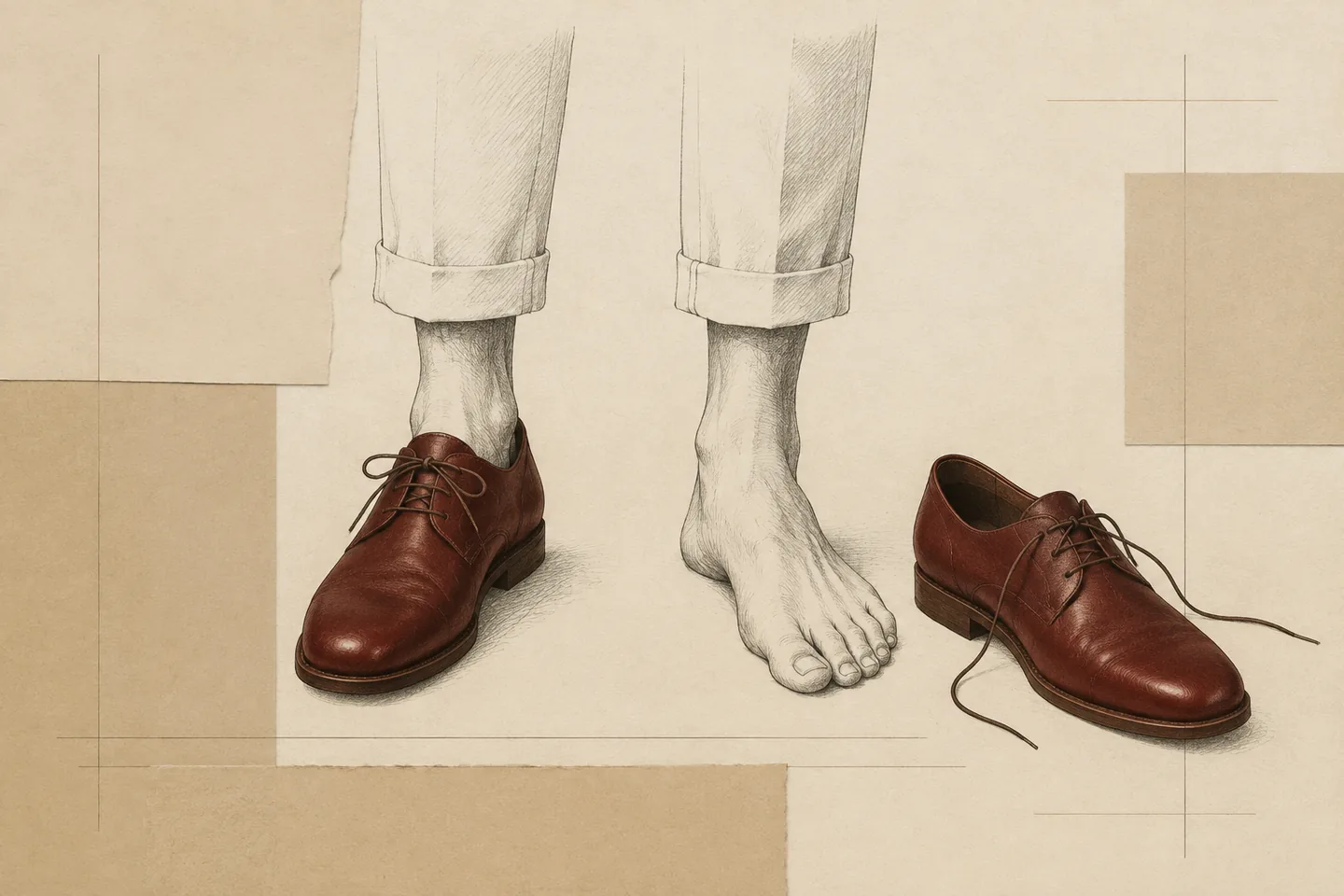
“One shoe on, one shoe off” usually describes exactly what it says: someone has a shoe on one foot but not the other. The uncovered foot may be bare or wearing a sock. The phrase can describe an interrupted routine, recall a nursery rhyme, or suggest incomplete preparation in a particular story.
It does not supply one fixed figurative meaning wherever it appears. Begin with the physical scene, then look at the surrounding words. A person changing footwear needs a different explanation from a character described metaphorically as unable to commit to leaving.
The nursery rhyme connection
The phrase appears in the traditional nursery rhyme Diddle, Diddle, Dumpling, about a child going to bed partly dressed. One shoe has come off while the other remains on. The clothing detail makes an ordinary bedtime routine comically incomplete. Read the Lit2Go text of “Diddle, Diddle, Dumpling.”
The joke requires little explanation: the child is in bed without having finished undressing. The verse does not tell us exactly why. Tiredness or distraction might fit the scene, but either would be an interpretation rather than a fact established by the shoe line.
Printed versions provide a way to check remembered wording. The Project Gutenberg edition of Halliwell’s collection includes the rhyme among other traditional nursery material. When discussing a particular version, distinguish the words on that page from details recalled from childhood.
You may remember trousers, britches or stockings, and the order of “on” and “off” may differ. These variations leave the central picture intact. They do matter when quoting, however: a remembered combination of two versions should not be presented as the exact text of either one.
Literal description or being half-ready?
In everyday speech, the phrase can capture someone partway through dressing. “I was one shoe on, one shoe off when the bell rang” suggests an interruption. It leaves open whether the speaker was putting shoes on or taking them off; the surrounding account should resolve that detail if it matters.
Other literal explanations include a missing shoe, changing footwear or removing a wet shoe. None needs a symbolic reading. A photograph showing one uncovered foot records an appearance, but without more information it cannot establish the person's reason for it.
“Half-ready” is a reasonable interpretation when the sentence concerns preparation. It is less useful if the person has deliberately removed one shoe and has no intention of going anywhere. Avoid turning a plausible explanation for one scene into a definition that must apply to every scene.
A writer can also use the image metaphorically. A character caught between staying and leaving might feel as though only one foot is ready. In that case, hesitation comes from the comparison and the story around it. The phrase alone does not prove indecision, confusion or any particular state of mind.
A different expression: the shoe is on the other foot
“The shoe is on the other foot” concerns a reversal of circumstances or roles. It does not describe someone wearing only one shoe. See Merriam-Webster’s definition of “the shoe is on the other foot.”
For example, someone who once assessed another person's work may later have their own work assessed by that person. The roles have reversed, so the idiom fits. No actual footwear needs to be involved.
By contrast, someone answering the door halfway through getting dressed may literally have one shoe on and one shoe off. Replacing that description with the other expression would introduce a reversal the scene has not established. Shared vocabulary does not make the phrases interchangeable.
Does it have a hidden meaning?
The shoe line by itself gives no basis for a claim about bad luck, supernatural activity or a prediction. The nursery rhyme can be understood through its bedtime scene without adding any of those ideas. An interpretation needs supporting context beyond the unusual appearance of one uncovered foot.
If someone offers a folklore explanation, ask which tradition, text or version supports it. A documented belief in one setting would not automatically explain every use of the phrase. Likewise, a personal association may matter to the person describing it without becoming a general meaning in English.
Historical commentary on nursery verse provides context for thinking about interpretation. Read Saintsbury’s introduction to the nursery-rhyme collection. Keep a distinction between the wording of a rhyme, commentary about nursery rhymes generally, and a claim about the origin of one particular line.
Why the image works in writing
A pair of shoes creates an expectation of matching feet. Showing only one shoe breaks that expectation with a detail readers can picture immediately. It can make a scene feel unfinished without requiring a long account of what happened before the interruption.
The opposing words “on” and “off” reinforce the contrast. In a short verse, that clear difference helps the image fit the rhythm. In prose, the same detail can establish a moment quickly: a person has paused between two parts of a familiar action.
The tone depends on what else is happening. At bedtime the mismatch may be comic; beside a muddy path it may be practical. A serious surrounding scene can give the detail a different effect. Do not assume that the phrase always signals humour simply because it appears in a nursery rhyme.
How to interpret an unfamiliar example
- Read the complete sentence. Check who has the shoe on and whether the text describes an actual action, a remembered verse or a comparison.
- Look for rhyme clues. Bedtime, a child and wording about stockings or trousers may point towards the nursery rhyme, especially when its opening words also appear.
- Check the immediate explanation. Dressing, a missing shoe or a change of footwear may account for the detail without a figurative reading.
- Test a metaphor against the passage. Incompleteness or hesitation should connect to something the writer has actually described, rather than an idea supplied by the reader.
A search snippet may omit the sentence that explains the image. Open the surrounding passage before deciding what it means. If the wording comes from a caption or an isolated message, acknowledge that there may not be enough context to choose between several ordinary explanations.
Also distinguish observation from explanation when answering someone else. “The person is wearing only one shoe” reports what is visible. “The person was interrupted while dressing” adds a cause. Unless the passage supplies that cause, describe it as a possibility rather than treating it as part of the phrase itself.
Using the phrase clearly
For a literal scene, add the action that makes the image useful: “She stopped tying her laces to answer the door, one shoe on and one shoe off.” The reader understands the interruption without needing a separate explanation of the expression.
For a metaphor, make the connection visible: “He felt half-ready to move, as though he had one shoe on and one shoe off.” This is an illustrative comparison, not a quotation from a source or a claim that the phrase has a formal definition about moving house.
When quoting the nursery rhyme, copy the wording from the edition you are using, including the order of the shoe details. When paraphrasing it, say that you are describing the scene. In translation, preserve the physical contrast and check whether readers need a brief explanation of the rhyme reference.